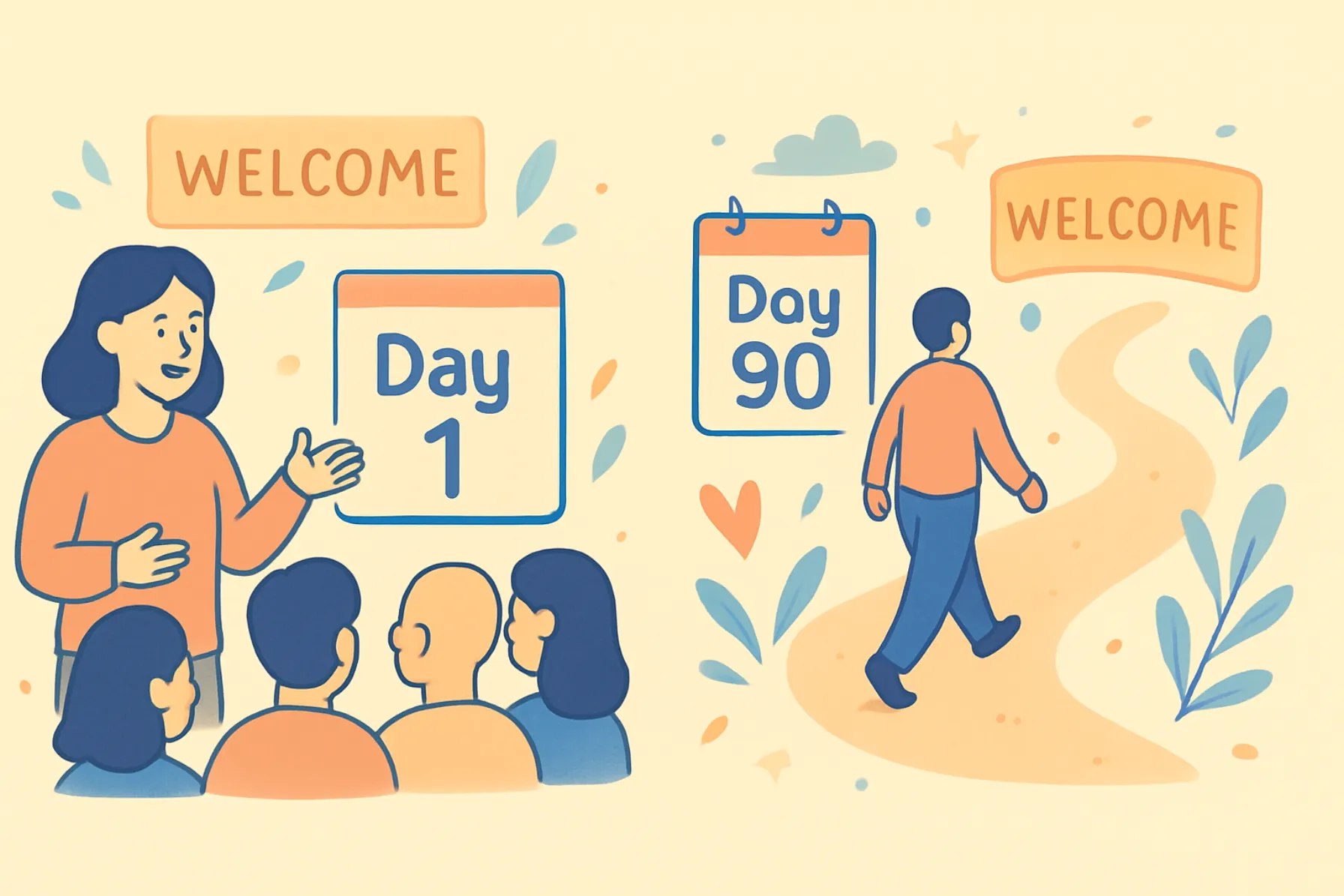
Here’s a stat that should stop every HR leader in their tracks: 43% of companies complete their entire “onboarding” process in a single day. They’re not onboarding. They’re orienting. And there’s a massive difference between the two.
That difference shows up in your retention numbers, your productivity metrics, and ultimately your bottom line. Organizations with strong onboarding improve new hire retention by 82%. Organizations that stop at orientation and call it done? They’re the ones watching 20% of their new hires walk out the door within 45 days.
If you’ve ever wondered whether orientation and onboarding are the same thing, this guide will make the distinction clear—and show you why getting it right matters more than you think.
Onboarding vs Orientation at a Glance
Before we dive into the details, here’s a side-by-side comparison of the two:
| Orientation | Onboarding | |
|---|---|---|
| Duration | 1-3 days | 90 days to 1 year |
| Scope | One-time event | Ongoing process with multiple phases |
| Focus | Paperwork, policies, logistics | Role mastery, culture integration, relationships |
| Who leads it | HR department | Managers, buddies, and cross-functional teams |
| Goal | Get new hires set up and compliant | Get new hires productive, engaged, and committed |
| Timing | Day 1 (sometimes Day 1-3) | Day 1 through Day 90+ |
| Content | Handbook, benefits, IT setup, office tour | Training, mentoring, feedback, goal-setting, social integration |
| Customization | Standardized for all new hires | Tailored to role, team, and individual |
Think of it this way: if onboarding is the entire journey from new hire to fully productive team member, orientation is the first stop on that journey. Important? Absolutely. But it’s just the beginning.
Why the Distinction Matters More Than You Think
Confusing orientation with onboarding isn’t just a terminology problem—it’s a retention problem.
The numbers tell a clear story. BambooHR found that 70% of new hires decide whether a job is the right fit within the first month, with 29% making that call in the first week. If all you’ve given them by then is a day of paperwork and a building tour, they’re forming opinions based on an incomplete picture.
And when that picture disappoints? They leave. Up to 30% of new hires leave within 90 days, and the cause is almost always traceable to how they were onboarded—not how they were hired.
The cost adds up fast. Gallup estimates that replacing a single employee costs one-half to two times their annual salary. For a mid-level hire earning $70,000, that’s $35,000 to $140,000 per departure. HR directors surveyed by Enboarder estimated the cost of a failed hire at $25,000 to $50,000.
Here’s the encouraging part: employees who had exceptional onboarding experiences are 2.6 times more likely to be extremely satisfied with their workplace. And 69% of employees are more likely to stay for three years or more when they receive a great onboarding experience. The investment pays for itself many times over.
What Orientation Covers (Days 1-3)
Orientation is the structured, short-term event that introduces new employees to the basics of working at your organization. It’s typically led by HR and follows a standard agenda for all new hires.
Here’s what a solid orientation should include:
Paperwork and compliance. Tax forms, benefits enrollment, employment agreements, I-9 verification, emergency contacts, and direct deposit setup. Necessary, not exciting—but it has to happen.
Company overview. Mission, vision, values, and a brief history. This gives new hires context for why the organization exists and what it’s working toward. Research from BambooHR shows that 91% of new hires who receive an effective introduction to company culture feel connected to their workplace—so don’t rush through this.
Workplace logistics. Office tour (physical or virtual), parking or commute details, where to find supplies, how to get into the building, and how to reach key contacts. For remote employees, this means a walkthrough of your digital workspace—communication tools, project management platforms, and shared drives.
IT and tools setup. Equipment check, email access, software logins, VPN configuration, and security training. 43% of new hires wait more than a week for all their tools and equipment, which is a solvable problem that creates unnecessary frustration.
Team introductions. Putting faces to names, even briefly, helps new hires start building their internal network. A warm welcome message from the manager and team can set the tone for the entire experience.
Policies and safety. Employee handbook review, code of conduct, safety protocols, and any compliance training required before the new hire can begin work.
Orientation done well makes someone feel expected, prepared, and legally squared away. But it doesn’t make them productive, engaged, or connected to their team.
What Onboarding Covers (Day 1 Through Day 90)
Onboarding is the comprehensive, ongoing process that transforms a new hire into a fully integrated, productive team member. According to SHRM, it includes orientation but extends to socialization, acculturation, training, and coaching—and can last up to 12 months.
The most effective framework is the 30-60-90 day plan. Here’s what each phase looks like:
Days 1-30: Foundation
This is the learning phase. New hires are absorbing how the company works, building initial relationships, and getting clarity on expectations.
- Role-specific training and clear success metrics
- Weekly one-on-ones with their manager (this matters—new hires are 3.4 times more likely to rate onboarding as exceptional when their manager is actively involved)
- An assigned onboarding buddy for informal guidance
- First small project to build confidence and create early wins
- 30-day review to check progress and address concerns
For a detailed task-by-task breakdown, see our complete onboarding checklist with 30-60-90 day framework.
Days 31-60: Integration
The new hire moves from learning to doing. They’re taking on real responsibilities with increasing independence.
- Ownership of specific projects and deliverables
- Cross-functional introductions beyond the immediate team
- Feedback on work quality and communication style
- Skills development based on identified gaps
- 60-day check-in on performance and engagement
Days 61-90: Contribution
By now, the new hire should be approaching full productivity and starting to own their role.
- Independent project ownership
- Career development conversation with manager
- Mentorship relationship established
- 90-day review: comprehensive performance and experience assessment
- Celebration of successful onboarding completion
Harvard Business Review research shows it takes up to a full year for new employees to reach peak productivity. The 90-day framework covers the most critical period—when 86% of new hires are deciding how long they’ll stay.
How Orientation and Onboarding Work Together
Orientation and onboarding aren’t competing approaches—they’re sequential phases of the same process. Orientation is the launchpad. Onboarding is the journey.
One helpful framework is SHRM’s 4 C’s of onboarding:
- Compliance — legal requirements, policies, paperwork
- Clarification — role expectations, goals, success metrics
- Culture — organizational norms, values, how things actually work
- Connection — interpersonal relationships, team dynamics, belonging
Orientation typically covers the first two C’s: compliance and clarification. That’s important groundwork. But it’s onboarding—the months-long process—that tackles culture and connection, which are the factors most strongly linked to long-term retention and engagement.
Here’s how the timeline flows:
- Pre-Day 1 (preboarding): Equipment shipped, accounts created, welcome message sent, introduction email shared with the team
- Days 1-3 (orientation): Paperwork, company overview, IT setup, team introductions, office tour
- Days 1-30 (onboarding Phase 1): Role training, buddy pairing, manager check-ins, first project
- Days 31-60 (onboarding Phase 2): Increasing autonomy, cross-team exposure, skill development
- Days 61-90 (onboarding Phase 3): Full productivity, career conversation, formal review
Companies like Google survey new hires at 30, 90, and 365 days—measuring access to tools, ability to feel productive, and sense of connection to culture. That data-driven approach contributed to a 25% increase in new employee productivity.
Onboarding vs Orientation for Remote and Hybrid Teams
Remote work makes the orientation-to-onboarding transition even more critical—and more likely to break down.
The data is sobering: 74% of employees rated their remote onboarding experience as a failure. Without the built-in social cues of an office—hallway conversations, casual lunches, ambient learning—remote new hires depend entirely on structured support.
What changes for remote orientation:
- Physical tours become virtual workspace walkthroughs
- In-person introductions become scheduled video calls
- “Stop by my desk” becomes “message me on Slack” (which feels different when you’re new)
- Communication norms must be explicitly documented—not absorbed by osmosis
What changes for remote onboarding:
- Buddy systems become even more important (new hires need someone they can reach easily)
- Documentation needs to be comprehensive—remote employees can’t overhear the answer
- Check-ins need to be more frequent, not less
- Social integration requires deliberate effort
Interestingly, hybrid onboarding leads to the highest satisfaction at 75%, outperforming both fully remote (71%) and fully in-person (73%) formats. The combination of face-to-face connection with flexible digital support seems to be the sweet spot.
If you’re building a remote onboarding program, our remote onboarding checklist walks through every phase from preboarding through Day 90.
Making New Hires Feel They Belong from Day One
Here’s something the comparison tables won’t tell you: the emotional experience of the first few days matters as much as the logistical experience.
BambooHR found that 44% of employees have regrets or second thoughts within the first week. That’s nearly half your new hires wondering if they made a mistake. What pulls them through that doubt? Feeling welcomed. Feeling valued. Feeling like they belong.
This is where orientation and onboarding both play a role:
During orientation, team welcome rituals set the emotional tone. A thoughtful welcome message, a team lunch (virtual or in-person), and genuine introductions signal that this person was expected and wanted. Even small gestures—a welcome card signed by the team, a Slack channel announcement with warm replies—change how someone feels about showing up on Day 2.
During onboarding, belonging deepens through consistent connection. Manager check-ins, buddy conversations, inclusion in team celebrations, and recognition of early contributions all reinforce that the new hire is part of the team—not just filling a seat.
If your team uses Cheerillion for group cards and celebrations, looping in a new hire on their first team birthday card or milestone celebration is a natural way to build connection. It says: you’re one of us now.
The first day at work sets the foundation for everything that follows. Make it count.
Common Mistakes to Avoid
Years of onboarding research point to the same recurring failures. Here are the ones that matter most:
1. Treating Orientation as the Entire Onboarding
This is the mistake that started this article. If your onboarding program ends after a day or a week of orientation activities, you’re leaving your new hires to figure out the rest on their own. Only 12% of employees say their company does onboarding well—and this is the primary reason.
2. No Manager Check-Ins in the First Week
Employees who met with their manager one-on-one during their first week developed stronger internal networks, had more productive meetings, and were more collaborative. Yet 28.8% of managers provide zero guidance to new hires. Manager involvement isn’t optional—it’s the single biggest predictor of onboarding success.
3. Information Overload on Day One
Your new hire cannot absorb the company’s entire history, technology stack, organizational chart, and project details in eight hours. Spread critical information across the first 30 days, prioritizing what’s immediately useful and layering in context over time.
4. Ending Onboarding After Two Weeks
It takes 6-7 months on average for employees to feel settled in their role. Pulling support after two weeks creates a gap during the most vulnerable period of the employee lifecycle. Keep the structure going through 90 days at minimum.
5. Ignoring Remote-Specific Needs
The same orientation agenda doesn’t translate from in-office to remote. Remote workers feel 25% more isolated than their on-site peers. They need more documentation, more intentional relationship-building, and more frequent touchpoints—not the same program delivered over Zoom.
Orientation Gets People Started. Onboarding Gets People Staying.
The distinction between orientation and onboarding isn’t semantic—it’s strategic. Orientation handles the logistics of Day 1. Onboarding builds the engagement, skills, and connections that determine whether someone is still with you on Day 365.
The good news? You don’t have to build everything from scratch. Start with a solid orientation that makes new hires feel welcomed and prepared. Then extend it into a structured onboarding process with clear milestones, manager involvement, and regular check-ins.
Ready to put this into practice? Start with our complete onboarding checklist for a detailed 30-60-90 day plan, or grab our remote onboarding checklist if your team is distributed.
Your new hires already chose you. Now give them a reason to keep choosing you—every day for the next 90 and beyond.
Want to make every new hire feel celebrated from day one? Cheerillion helps teams send group cards for birthdays, work anniversaries, and welcome moments—so no one starts their journey feeling invisible.