Here’s a gap worth closing: 76% of professionals say mentors are important, but only 37% actually have one. Meanwhile, 87% of organizations that invest in coaching report a positive ROI — yet many HR leaders still struggle to articulate when coaching is the right call versus when mentoring would serve their people better.
The confusion is understandable. Both involve one-on-one developmental conversations. Both improve performance and retention. And both show up in every L&D strategy deck. But they serve fundamentally different purposes, and deploying the wrong one at the wrong time wastes budget, frustrates participants, and leaves real development gaps unaddressed.
This guide breaks down the actual differences, gives you a decision framework for when to use each, and walks through how to build both programs — backed by data from organizations that have done it well.
Coaching vs Mentoring: What’s Actually Different?
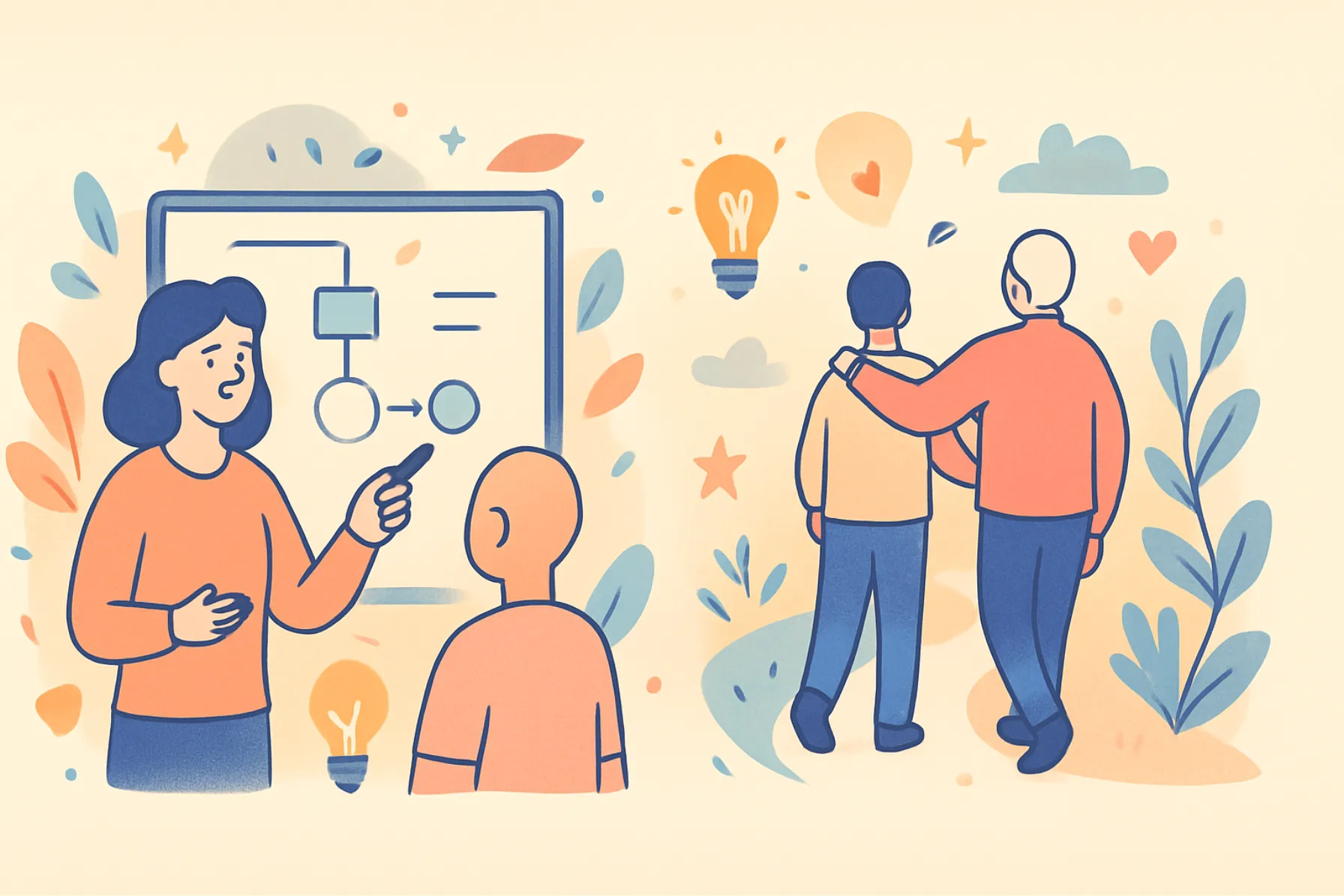
The simplest way to understand the distinction: coaching develops a specific skill; mentoring develops a whole person.
A coach helps someone get better at something defined — leading meetings, giving feedback, managing conflict. A mentor helps someone navigate broader questions — career direction, organizational politics, leadership identity.
Here’s how the differences play out across the dimensions that matter most:
| Dimension | Coaching | Mentoring |
|---|---|---|
| Primary focus | Specific skills or performance goals | Career growth and personal development |
| Timeframe | Short-term (3-12 months) | Long-term (1-2+ years) |
| Who drives it | Joint agenda, coach structures the process | Mentee drives the agenda |
| Approach | Asks questions to unlock self-discovery | Shares experience and gives advice |
| Expertise needed | Trained in coaching methodology | Deep domain or organizational experience |
| Outcomes | Measurable, specific results | Broader growth, often intangible |
| Relationship style | Professional, structured | Personal, trust-based |
| Best for | Performance gaps, skill building, transitions | Career navigation, culture transfer, leadership pipeline |
The CIPD defines coaching as “a non-directive form of development focused on improving performance,” while mentoring involves “a more experienced colleague sharing their greater knowledge to support the development of an inexperienced individual.” The ATD draws a similar line: coaches guide people to discover their own answers; mentors share what they’ve learned from walking the path first.
Neither is inherently better. They’re different tools for different jobs.
Coaching vs Managing: The Third Piece of the Puzzle
Since we’re untangling these terms, let’s address a related confusion: coaching is not managing, and confusing the two undermines both.
Managing is about directing work — setting expectations, assigning tasks, monitoring outcomes, and making sure the team delivers. It’s operational and results-driven.
Coaching is about developing people — asking questions that build self-awareness, helping someone work through a challenge instead of just solving it for them. It’s growth-driven.
The best leaders blend both approaches depending on the situation. When someone needs clarity on what to do, manage. When someone needs to grow in how they think, coach. A leader who only manages burns people out. A leader who only coaches may miss deadlines.
The practical takeaway: managers don’t need to become certified coaches. But learning to ask better questions — instead of always providing answers — transforms the quality of one-on-one check-ins and makes development a daily practice rather than an annual event.
When to Use Coaching vs Mentoring: A Decision Framework
This is where most articles stop at definitions. Here’s what you actually need — a framework for deciding which approach fits the situation.
Choose coaching when…
- There’s a specific performance gap. An employee struggles with delegation, presentation skills, or time management. Coaching provides the structured practice and feedback loop to close that gap.
- Someone is navigating a role transition. New managers, newly promoted leaders, or people shifting functions benefit from coaching that builds specific competencies within a defined timeframe — the kind of high-leverage skills a first-time manager has to pick up fast in their first 90 days.
- You need measurable results. Coaching lends itself to clear before-and-after outcomes: improved 360 feedback scores, faster project delivery, stronger team engagement data.
- The knowledge exists but isn’t being applied. When someone knows what to do but can’t seem to do it consistently, coaching helps bridge the knowing-doing gap through accountability and reflection.
Choose mentoring when…
- An employee needs career guidance. Mentors provide the organizational wisdom, political awareness, and career perspective that no training course can teach.
- You’re building a leadership pipeline. Mentoring transfers the tacit knowledge — unwritten rules, relationship networks, decision-making instincts — that future leaders need and can’t get from a manual.
- Cultural integration matters. New hires, employees from underrepresented groups, or people joining after a merger benefit from mentors who can decode the culture and create belonging.
- Long-term retention is the goal. The data is emphatic: retention rates hit 72% for mentees compared to 49% for non-participants.
Use both when…
- Developing high-potential talent. The most effective leadership development programs layer coaching and mentoring together because they address different dimensions of growth. Coaching builds the skills while mentoring provides the context.
- Running succession planning. Pair future leaders with coaches for skill acceleration and mentors for organizational knowledge transfer. The CIPD recommends starting mentoring 18-36 months before leadership transitions.
- Supporting remote or distributed teams. Both approaches help bridge the connection gap, but they do it differently. More on that below.
The Data Behind Both Approaches
This isn’t a soft-skills nice-to-have. The numbers from organizations that have invested seriously in coaching and mentoring are striking.
Coaching ROI
The 2025 ICF Global Coaching Study reports that the global coaching industry has grown to $5.34 billion — up 17% since 2023. That growth is driven by results: 87% of organizations report positive ROI from coaching, with executive coaching typically delivering 5-7x return on investment. The Institute of Coaching found that over 70% of individuals who receive coaching report improved work performance, relationships, and communication.
Mentoring impact
The landmark Sun Microsystems study — tracking 7,000+ mentoring pairs over 14 years — found that mentees were promoted 5x more often than peers without mentors, and 25% experienced a salary grade change (compared to 5% without mentoring). The program’s ROI exceeded 1,000%.
More recent data confirms the pattern. Cox Automotive achieved a 79% retention rate among mentoring participants versus a 67% company average. MentorcliQ’s 2024 report found that companies with mentoring programs have 2x higher median profits and that 98% of Fortune 500 companies now maintain formal mentoring programs.
The takeaway: both approaches work. The question is which one addresses your current challenge.
How to Build a Coaching Culture
You don’t need a massive budget or external consultants to start. The most scalable approach is equipping your managers to coach.
Start with the GROW model. Developed by Sir John Whitmore, GROW stands for Goal (what do you want?), Reality (where are you now?), Options (what could you do?), and Will (what will you commit to?). It’s simple enough to teach in a two-hour workshop and powerful enough to transform how managers run their one-on-ones.
Embed coaching into existing rhythms. You don’t need separate “coaching sessions.” Turn your regular check-ins into coaching conversations by shifting from “how’s the project going?” to “what’s the biggest challenge you’re working through, and what have you tried so far?” Skip-level meetings are another natural coaching touchpoint — they give senior leaders a chance to develop people they don’t manage directly.
Train, then support. Train managers on active listening, open-ended questioning, and giving constructive feedback. Then provide peer learning circles where managers can practice and troubleshoot coaching conversations together.
Measure what matters. Track engagement scores, 360 feedback improvements, and internal mobility rates. Google found that its best managers were great coaches — which led to the CareerGuru program connecting employees with 350+ internal coaches and the g2g (Googler to Googler) peer coaching initiative.
How to Build a Mentoring Program
Formal mentoring programs close the participation gap — remember, most mentoring relationships don’t start through formal requests. Here’s how to build one that works.
Step 1: Define the purpose. Are you targeting retention of early-career talent? Leadership development? DEI goals? Cultural integration after a merger? The purpose shapes everything from matching criteria to success metrics.
Step 2: Recruit and match thoughtfully. Don’t just pair people by department or seniority. Consider shared interests, complementary skills, and career aspirations. Microsoft’s global program connects 50,000+ employees across time zones by matching on development goals rather than geography.
Step 3: Orient both parties. Mentors need to know they’re not there to give all the answers — they’re there to listen, share experience, and help mentees think through decisions. Mentees need to know they own the agenda. Set expectations on frequency, communication, and confidentiality.
Step 4: Create psychological safety. Mentoring only works when people feel safe being honest about their challenges, gaps, and ambitions. This means the relationship must be separate from performance evaluation. What’s shared in mentoring stays in mentoring.
Step 5: Monitor and iterate. Check in with pairs quarterly. Track participation rates, satisfaction scores, and downstream outcomes like retention and promotion rates. General Electric’s reverse mentoring program — pairing younger employees with senior leaders for bidirectional learning — evolved over years of iteration and became a model other organizations replicated.
Making Coaching and Mentoring Work in Remote Teams
Both coaching and mentoring translate well to remote and hybrid environments — but they require intentional design rather than hoping it happens organically.
For coaching: Virtual coaching actually works well because the structured nature of coaching sessions (defined goals, specific timeframes, clear agendas) maps naturally to video calls. The key is consistency: keep sessions on the calendar and protect them from being bumped by “urgent” meetings.
For mentoring: Remote mentoring requires more deliberate relationship-building. Harvard Business Review recommends starting with five-minute personal check-ins before diving into development topics. Use a mix of video calls for deeper conversations and async channels (Slack, email) for quick questions and encouragement between sessions.
The equity advantage: Remote mentoring can actually be more equitable. Without geographic constraints, you can match people based on genuine fit rather than who sits on the same floor. This expands the pool of potential mentors significantly and helps reduce the in-person biases that can creep into informal mentoring.
For more on building development practices in distributed teams, see our guide on what makes high-performing teams work.
How Recognition Powers Both
Here’s something the research consistently shows but few articles connect: coaching and mentoring are dramatically more effective in cultures where recognition already exists.
When people feel valued, they’re more receptive to feedback. When growth is celebrated — not just outcomes but the effort to develop — more people opt into coaching and mentoring programs voluntarily. And when mentors are publicly recognized for the time they invest, more experienced employees volunteer to mentor.
Gallup’s engagement data shows that recognition is one of the core drivers of employee engagement. It creates the psychological foundation on which development thrives. Organizations that layer regular recognition — through check-ins, team celebrations, and peer acknowledgment — see higher uptake and better outcomes from their coaching and mentoring investments.
The practical move: build recognition into the fabric of your coaching and mentoring programs. Celebrate milestones in the mentoring relationship. Acknowledge coaches and mentors in team meetings. And make sure the people being developed feel seen for their progress along the way.
Getting Started
You don’t need to build both programs at once. Start with where you’ll get the most impact:
- If your biggest gap is manager effectiveness, start with coaching. Train managers in the GROW model and embed coaching questions into existing check-ins.
- If your biggest gap is retention or career development, start with mentoring. Even an informal pilot program with 10-15 pairs generates data and stories that build organizational buy-in.
- If you’re building a leadership pipeline, invest in both. The research is clear that the combination is more powerful than either alone.
The organizations getting the best results — Google, Microsoft, Cox Automotive, and countless others — aren’t choosing between coaching and mentoring. They’re layering both into a development ecosystem where every employee has access to the type of support they need, when they need it.
That’s not an overnight transformation. But it starts with knowing the difference, choosing your starting point, and building from there.